- Wise Words Weekly
- Posts
- MJ DeMarco's Wise Words On Taking MASSIVE Action!
MJ DeMarco's Wise Words On Taking MASSIVE Action!
📈Your Path to Constant Progress & Improvement

Grant Shay
July 22, 2025
A powerful quote, a simple action, and a spark to ensure your continued progress—welcome to Wise Words Weekly!
🤔Every week, we disect, investigate, and unpack a wisdom-packed quote from a wise, successful, and inspirational person. We explore many different self-development topics such as your Personal Growth, Mindset, Well-Being, Relationships, Leadership, and Gratitude. The Wise Words Weekly newsletter is designed to spark your continued progress, one small step at a time. 📈 None of this content should be construed as any type of investment or other professional advice. If you like quotes as much as we do, you may enjoy our Wise Words YouTube channel, too. Click here to check it out.
This week, we’re diving into Taking MASSIVE Action!
🔥Quote of the Week:
“The owner of an idea is not he who imagines it, but he who executes it.” ― M.J. DeMarco, The Millionaire Fastlane

🤔Reflection:
Ideas are like seeds. They hold incredible potential but remain dormant without taking massive action. M.J. DeMarco’s quote reminds us that dreaming up a brilliant concept is only the starting point; true ownership comes from the courage, mindset, and discipline to bring it to life. Reflect on the ideas you’ve had recently, perhaps a business venture, a creative project, or a personal goal. How many have stayed locked in your mind, waiting for the “perfect” moment? The gap between ideation and execution is where most dreams die, but it’s also where the big opportunity lies.
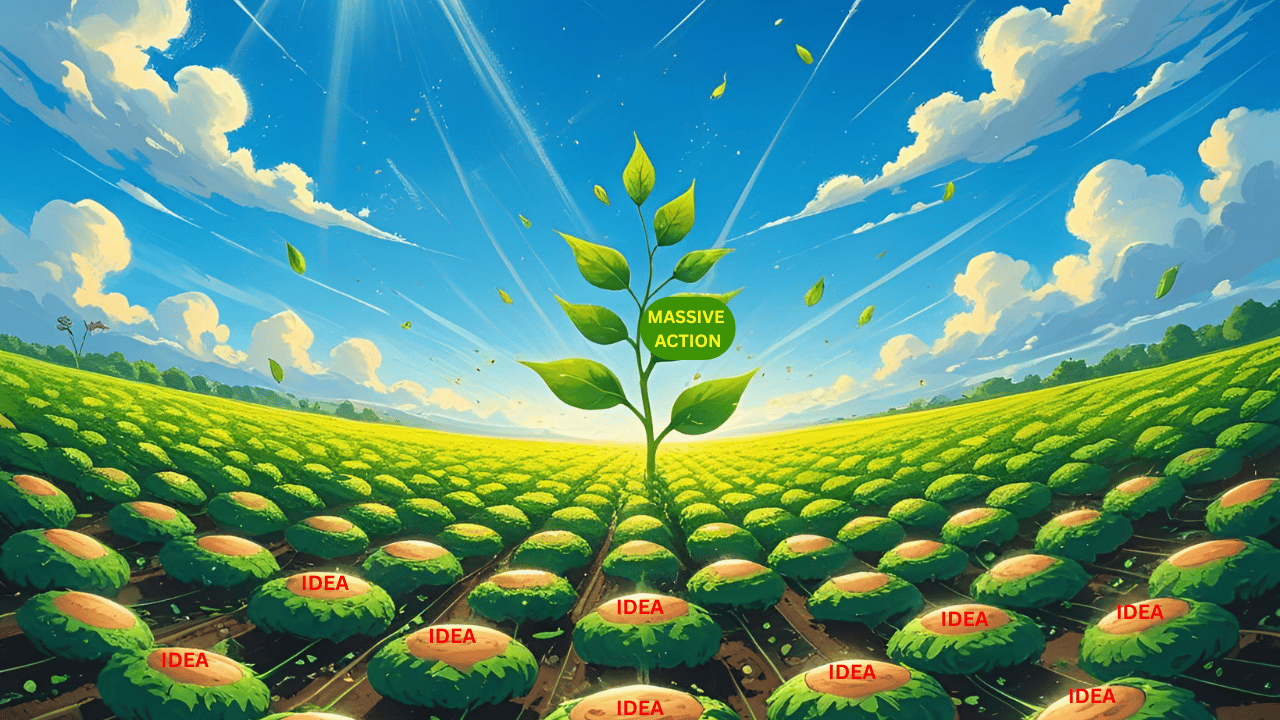
Consider the weight of inaction. Every day you delay, someone else might take a similar idea and run with it, not because they’re smarter, but because they acted. Execution isn’t about perfection—it’s about progress, learning, and adapting as you go. Think about what’s holding you back: fear of failure, lack of resources, or simply not knowing where to start. Recognizing these barriers is the first step to overcoming them and claiming ownership of your ideas.
This quote challenges us to redefine what it means to “own” something. It’s not enough to say, “I thought of that first.” Ownership is earned through sweat, iteration, and resilience. Take a moment to ask yourself: What idea am I ready to claim, not just in my mind, but in the world?

🏆Why This Can Be Your Superpower
Execution is a superpower because it transforms the intangible into reality. While ideas are abundant, the ability to act on them sets you apart in a world full of dreamers. When you execute, you build momentum, gain clarity, and create opportunities that others only imagine. This skill isn’t reserved for a select few—it’s accessible to anyone willing to take consistent, intentional steps.

Imagine the confidence that comes from seeing your ideas take shape, whether it’s launching a side hustle, writing a blog, or organizing a community event. Execution breeds trust in yourself, proving you can bridge the gap between vision and outcome. It’s also a magnet for collaboration—people are drawn to those who make things happen, opening doors to partnerships, resources, and growth.
The beauty of execution as a superpower is its compounding effect. Each small action builds skills, networks, and results that amplify your next effort. Unlike innate talent, execution is a muscle you strengthen over time. By prioritizing action over perfection, you unlock a cycle of progress that can redefine your personal and professional life.

🔬The Science Behind It
Neuroscience reveals why execution trumps ideation. The brain’s prefrontal cortex, responsible for planning and decision-making, lights up when you generate ideas, but it’s the basal ganglia, which governs habit formation and action, that drives results. When you act on an idea, you engage the brain’s reward system, releasing dopamine that reinforces the behavior and motivates further action. This creates a positive feedback loop, making execution easier over time.

Psychological studies, like those on the Zeigarnik effect, show that uncompleted tasks linger in our minds, causing stress and distraction. By taking even a small step toward executing an idea, you reduce cognitive load and gain mental clarity. This explains why starting a project—however imperfectly—feels liberating. Action shifts your brain from ruminating to problem-solving, unlocking creativity and focus.
Research on “implementation intentions” by psychologist Peter Gollwitzer highlights the power of specific plans. When you define when, where, and how you’ll act (e.g., “I’ll write 200 words every morning at 7 a.m.”), you’re 2–3 times more likely to follow through. Execution isn’t about willpower alone; it’s about designing systems that make action inevitable. By understanding these mechanisms, you can hack your brain to prioritize doing over dreaming.
Use Google Docs (or something similar) to start a to-do list. Visit it every morning and every night at the same time. Set an alarm on your phone to remind you. Each time, journal the actions you have take and strike through the tasks that have been completed. This becomes a very rewarding experience that fuels your fire and your chances for massive success.

🧬Stories That Bring It to Life
In 2008, Brian Chesky and Joe Gebbia had an idea to rent out air mattresses in their San Francisco apartment to offset rent. The concept of Airbnb was born, but it wasn’t the idea that made it a global phenomenon—it was their relentless execution. They coded a basic website, pitched to skeptical investors, and iterated through countless rejections. Their first “office” was a living room, yet their willingness to act, adapt, and persist turned a quirky idea into a billion-dollar company.

Or, take Codie Sanchez for instance. Codie Sanchez embodies the power of execution by turning her vision of financial freedom into reality through strategic action. After years in finance, she left a high-flying career at Goldman Sachs to buy “boring” businesses like laundromats and car washes, which she scaled into a portfolio worth billions in combined valuation. Her first laundromat, purchased at 29, was projected to generate $5 million in revenue within two years because she didn’t just dream about passive income—she studied the market, negotiated deals, and optimized operations. Sanchez’s Contrarian Thinking newsletter and courses now inspire over 100,000 people to act on their entrepreneurial ideas, proving that execution, not just ideation, builds wealth and impact.
Or, consider James Clear, who transformed a simple idea—writing about habits—into a movement. He started by posting articles on a modest blog in 2012, committing to two posts a week. His consistent execution, refining ideas based on reader feedback, led to Atomic Habits, a book that’s sold over 15 million copies. These stories show that execution, not the idea alone, creates lasting impact.
And finally, we have M.J. DeMarco, the author of the quote itself. MJ is a living testament to the power of execution. Frustrated with the traditional "get a job, save, and retire" model, he envisioned a life of financial freedom through entrepreneurship. Instead of just dreaming, he built and sold a lead-generation website, Limos.com, for millions in his 20s by relentlessly refining the platform, learning coding, and marketing it himself. He didn’t stop there; DeMarco executed again by writing The Millionaire Fastlane, self-publishing it when traditional publishers rejected him, and building a global audience through forums and blogs. His ability to act on his ideas, iterate through failures, and create scalable systems turned his vision into a legacy that inspires millions.
I highly recommend you read the books and/or newsletters of all of these people. They are all absolutely fantastic!

🏃♂️How to Start Today
Begin by choosing one idea you’ve been holding onto—a project, goal, or change you want to make. Write it down and break it into the smallest possible first step. If you want to start a podcast, your step could be researching one piece of equipment or drafting a single episode outline. The key is to act within 24 hours to build momentum.

Create a simple system to stay consistent. Use the “two-minute rule”: start tasks that take less than two minutes (e.g., opening a document, sending an email). This bypasses procrastination and tricks your brain into continuing. Schedule a specific time and place for your next step, leveraging implementation intentions to make action automatic.
Surround yourself with accountability. Share your goal with a friend, join a community, or use apps like Trello to track progress. Celebrate small wins to reinforce the habit—maybe treat yourself to coffee after completing a task. Execution thrives on clarity, commitment, and small, repeatable actions that build toward your vision.

🎇A Challenge to Spark Change
This week, commit to executing one idea you’ve been delaying. Pick something meaningful but manageable—a blog post, a workout plan, or a business pitch. By the end of the week, take at least three concrete steps toward it. For example, if your idea is to start a side hustle, your steps could be: 1) researching one competitor, 2) drafting a one-page plan, and 3) contacting a potential customer or mentor.

Track your progress in a journal or share it with a friend for accountability. Reflect on how taking action feels compared to just thinking about the idea. The goal isn’t perfection but movement. If you hit a roadblock, adjust and keep going—execution is about persistence, not flawless performance.
To make it fun, reward yourself for completing the three steps. It could be a small treat, like watching a favorite show guilt-free, or sharing your progress online to inspire others. Tag us with #ExecuteYourIdea, and we’ll feature some of your stories in next week’s newsletter!

📖 📙A Great Book To Read On This Topic":
In addition to the books and newsletters previously mentioned, another great book on this topic is, “The 5 Second Rule” by Mel Robbins. It is a must-read for mastering execution. Robbins shares her simple yet powerful technique: counting down 5-4-3-2-1 to push past hesitation and act on your ideas. Backed by science and personal stories, the book explores how small actions can break the cycle of overthinking and lead to transformative results.
Unlike typical self-help books, Robbins focuses on practical, immediate steps to build the habit of action. She draws on her own journey from financial struggle and self-doubt to becoming a global speaker, showing how execution can change your trajectory. The book is packed with real-world examples, from entrepreneurs to everyday people, who used the rule to turn ideas into reality.
It’s a quick, engaging read that pairs perfectly with DeMarco’s quote that inspired this weeks’ edition of Wise Words Weekly. You’ll walk away with a clear framework to stop procrastinating and start doing. Grab a copy, try the 5-second rule this week, and see how it sparks your ability to own your ideas through action.
If you don’t have the time to read a book, try listening to it on Audible.

🗣️Let’s Connect:
What’s something new you’re working on? Share it on 𝕏! @WiseWordsIQ
I’d love to hear your story and cheer you on!
🤔What’s Next?
Next week, expect another dose of wisdom (maybe we will touch on Leadership or Gratitude?) to keep your momentum going. Stay tuned for exclusive insights you won’t find on my X feed!
Here’s to your constant progress!
Your friend,
Grant
Find me on 𝕏: @WiseWordsIQ
P.S. Want to dive deeper into learning? Check out Mindset by Carol Dweck—a game-changer for growth!
P.P.S. 🔥Want to unlock the secret to a WINNING MINDSET?!💡 Like building muscle💪, you can train your brain🧠—but only if you know how.
Most people stumble through life, totally unaware their subconscious is silently sabotaging them. Limiting beliefs and habits they are completely unaware of are holding them back from living an absolutely fantastic life full of everything they want and deser shows you how to spot these invisible shackles, shatter them, and step into your power.💪
Act now! Your breakthrough awaits!🚀👇
